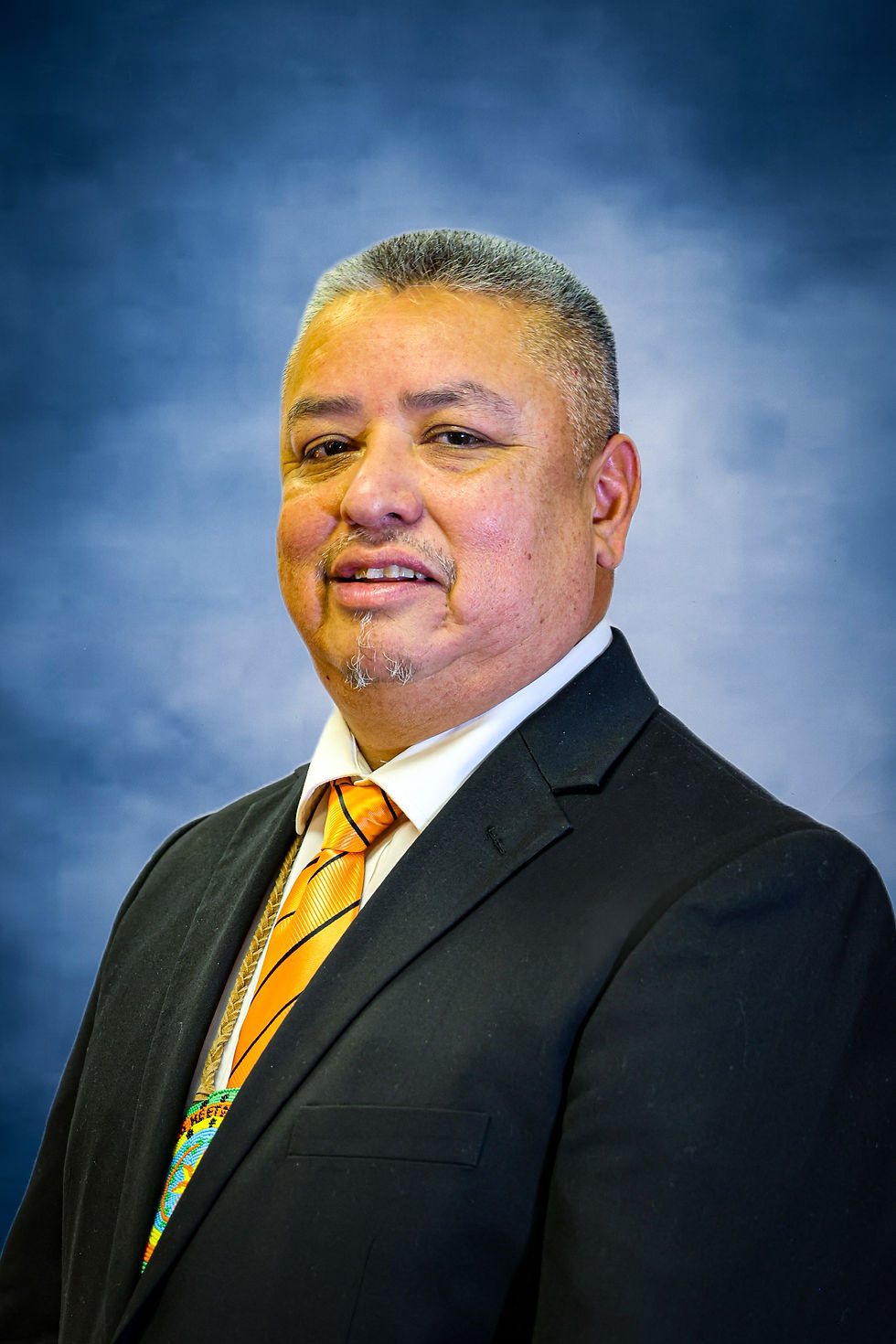
Testimony of Jeff Wachoche, Chief of The United Keetoowah Band of Cherokee Indians in Oklahoma
- Lani Hansen

- Dec 30, 2025
- 5 min read
Updated: Feb 2
U.S. House Subcommittee on Indian and Insular Affairs Oversight Hearing on “Modernizing the Implementation of 638 Contracting at the Indian Health Service”
Chairman Hurd, Ranking Member Leger Fernandez, and members of the Subcommittee:
It is my distinct honor to submit this testimony for the record on this hearing on behalf of the United Keetoowah Band of Cherokee Indians in Oklahoma (UKB). I do so to correct the record related to testimony provided by Cherokee Nation of Oklahoma (CNO) which characterized UKB’s participation in ISDEAA contracting with the Indian Health Service (IHS) as somehow demonstrative of a weakness in ISDEAA. While there are many areas in which ISDEAA can be improved, ISDEAA properly facilitating UKB’s participation in delivery of health services to UKB members in furtherance of UKB’s government-to-government relationship with the United States is not one of them. As to the issues raised by CNO related to UKB obtaining health funding after nearly 80 years as a federally recognized tribe, ISDEAA is working properly, at long last.
Tribal Sovereignty and ISDEAA
Where one Tribe seeks to assume operation of ISDEAA-eligible programs within a geographic area which serves more than one Tribe, ISDEAA requires that the requesting Tribe include in its proposal to IHS, authorizing resolutions from the governing bodies of the Tribes to be served. The statute and implementing regulations require such resolutions before the proposal can be considered complete.
The Oklahoma Cherokee Reservation is home to the Tahlequah Service Unit and the Claremore Service Unit. The Tahlequah Service Unit includes both CNO and UKB while the Claremore Service Unit includes CNO, UKB, and eleven additional federally recognized Tribes. Several years ago, CNO assumed operation of the Tahlequah Service Unit without the legally required authorization of the UKB. This improper action by IHS resulted in the shifting of UKB’s tribal shares within the Tahlequah Service Unit to the Cherokee Nation of Oklahoma, eliminating funding that was otherwise available for services to the UKB user population. UKB never provided the legally required authorizing resolution nor was it ever requested by IHS.
UKB submitted an ISDEAA proposal to the IHS wherein it requested funding solely based upon the UKB’s unique service population, carving out only that which UKB is entitled to and doing no harm to the funding levels of any other Tribe. However, because UKB is entitled to provide health programs to its unique user population but there were no tribal shares for UKB to assume, IHS requested that UKB withdraw its ISDEAA proposal while IHS determined how it would comply with its responsibility to UKB within the confines of ISDEAA and its trust responsibility to the UKB.
Since UKB’s withdrawal of its ISDEAA proposal, UKB and IHS worked to identify a unique and non-duplicative UKB user population. UKB provided IHS with its tribal roll. IHS’s statisticians compared the UKB tribal roll to IHS’s system-wide user census and identified the UKB population which were not receiving services from IHS or any ISDEAA Tribal Contractor including CNO. While UKB viewed the resulting total as underinclusive, UKB and IHS nonetheless agreed upon the smaller UKB user population in furtherance of the effort to avoid any chance of duplication. Simply put – any chance of duplication alleged by CNO is mitigated by IHS’s own due diligence in avoiding duplication of funding for any individual and UKB agreed to do so in furtherance of the same.
There are No Real Per Capita Funding Disparities
CNO alleges that IHS funds UKB’s PRC program at $2,600 per person while CNO receives $67 per person. While it is true that UKB received $5.6m in 2024 and that this funding went into the PRC line within UKB’s ISDEAA funding agreement, this is not the entire picture.
When determining the total amount of funding that UKB is eligible to receive from IHS, IHS relied upon a standard form that calculates the per capita spend by IHS in provision of services across the IHS system. IHS inserted the agreed-upon non-duplicative user population into the standard form and the standard formula produced a standard funding amount. This calculation would be the same on a per capita basis for any Tribe in any IHS Area Office. The calculation is equitable. UKB is entitled to $5.6m annually in secretarial funding for health programs.
The alleged disparity between CNO and UKB for PRC is easily explained. UKB is entitled to $5.6m annually. UKB assumed the PRC program as its first health PFSA and, using the authority of ISDEAA, programmed all of those 2024 funds into its PRC line while UKB worked to move its other PFSAs to contract. In 2025, UKB received the same $5.6m but this time received $4.6m within PRC and $1m in the Hospitals and Health Clinics (HHC) PFSA line. As UKB continues to bring additional PFSAs online under its ISDEAA agreement, the $5.6m will continue to be spread out among the lines and the PRC amount will decrease as the other lines increase. The entire UKB pie is $5.6m. Cutting that pie does not create more pie. ISDEAA’s framework for Tribal flexibility allows Tribes to move funding across the PFSAs to strategically allocate resources to best serve their Tribal communities. That is what the UKB has done here. That is also the stated policy of ISDEAA.
Protecting Provider Relationships and Avoiding Billing Confusion
Finally, CNO’s testimony alleges that UKB’s operation of its PRC program harm CNO’s relationship with outside providers and create confusion related to payment of PRC referrals. UKB vehemently denies that its operation of its PRC program attributes in any way to the relationship between CNO and its vendors. UKB recently learned from outside providers, however, that they were contacted by CNO staff inquiring about the status of payment for UKB’s PRC referrals and inquiring about how quickly UKB pays its claims.
While we can agree that there is a strain on the relationship between CNO and its outside providers, the strain is caused by CNO’s own efforts to interject itself into UKB’s contractual dealings with third parties. CNO’s testimony reflects its motives.
Conversation and Cooperation
UKB believes that the health, safety, and welfare on our shared Oklahoma Cherokee Reservation should be paramount in all decisions we make. We also believe that cooperation, not division, will always bear the best fruit. That is why we have repeatedly reached out to CNO to have a conversation about how we can cooperate in provision of care while respecting the sovereign status of our respective governments. We reached out prior to contracting with IHS, we reached out prior to standing up the PRC program. We reached out regarding provision of direct care moving forward. Our mature and responsible outreach has gone unanswered. If CNO truly wishes to protect access to care on the Oklahoma Cherokee Reservation, it would return UKB’s overtures in that spirit.
CNO’s Testimony as to UKB is not ISDEAA-Related
CNO’s testimony as it relates to UKB is not germane to the topic of this Hearing. In fact, nothing CNO dislikes about UKB’s exercise of its rights as a federally recognized Tribe to participate in ISDEAA evolves from any provision of ISDEAA. CNO makes no suggestion in its testimony as to which provisions of ISDEAA should be modernized to address their concerns about UKB’s administration of its ISDEAA contract.
Conclusion
UKB has a right as a federally recognized tribe to participate in ISDEAA and to administer health programs on behalf of its unique non-duplicative user population. UKB’s user population is based upon the most conservative calculations conducted by IHS itself. UKB’s total funding amount under its IHS ISDEAA contract is based upon IHS’s standard process and is on par with IHS’s annual per capita spending in provision of health services. UKB has a right under ISDEAA to allocate its contract funding in a manner which best serves the needs of its unique user population and UKB has done exactly this. UKB continues to stand ready to collaborate with CNO to identify appropriate and lawful mutually beneficial synergies between tribal health programs. While maintaining the spirit and purpose of ISDEAA, no amendment to “modernize” ISDEAA will touch any of CNO’s perceived and malevolent issues with UKB.
Wado!

Comments